Showing posts with label train. Show all posts

Sunday, February 4, 2024

Early Steam Railway History

The early development of trains in England witnessed a transition from horse-drawn railways to the introduction of steam-powered locomotives. Initially, these railways were primarily funded and constructed by mine owners, with the primary purpose of transporting coal and minerals. However, the emergence of public railways marked a crucial milestone in the history of transportation.

In 1803, the inception of the first public railway in London connecting Surrey and Croydon signaled a major shift. Spanning almost nine miles, this railway utilized horse-drawn carriages with wheels adapted for both rail and road use. These carriages, each capable of being pulled by a single horse, could transport up to five loaded wagons, each weighing 3 tons, on level ground.

Richard Trevithick played a pivotal role in advancing steam technology for land transportation. In 1804, he successfully demonstrated the inaugural steam engine designed specifically for rail transport, employed in hauling iron from Merthyr Tydfil to Abercynon.

The pivotal moment for steam-powered railways arrived with the contributions of English engineers George and Robert Stephenson. On September 27, 1825, the Stephenson brothers' locomotive, named Locomotion, drew open carriages along a railway, accommodating 450 passengers. This event marked the introduction of the first public locomotive service.

The culmination of these technological advancements resulted in the inauguration of the world's first passenger railroad between Liverpool and Manchester in 1830. However, prior to its establishment, a significant trial unfolded at Rainhill, England, in 1829. During this trial, various locomotives, including George Stephenson's "Rocket," competed to showcase their capabilities and efficiency. The success of the Rainhill Trials affirmed the practicality of steam-powered locomotives for public transportation, paving the way for the rapid expansion of railways in England and globally.
Early Steam Railway History

Monday, October 24, 2022

History of underground train in London

The first subway system was proposed for London by Charles Pearson, a city solicitor, as part of a city-improvement plan shortly after the opening of the Thames Tunnel in 1843.

Pearson published a pamphlet in 1845 detailing an underground railway though London’s Fleet Valley. In 1846, Pearson went before Parliament to detail the plan.

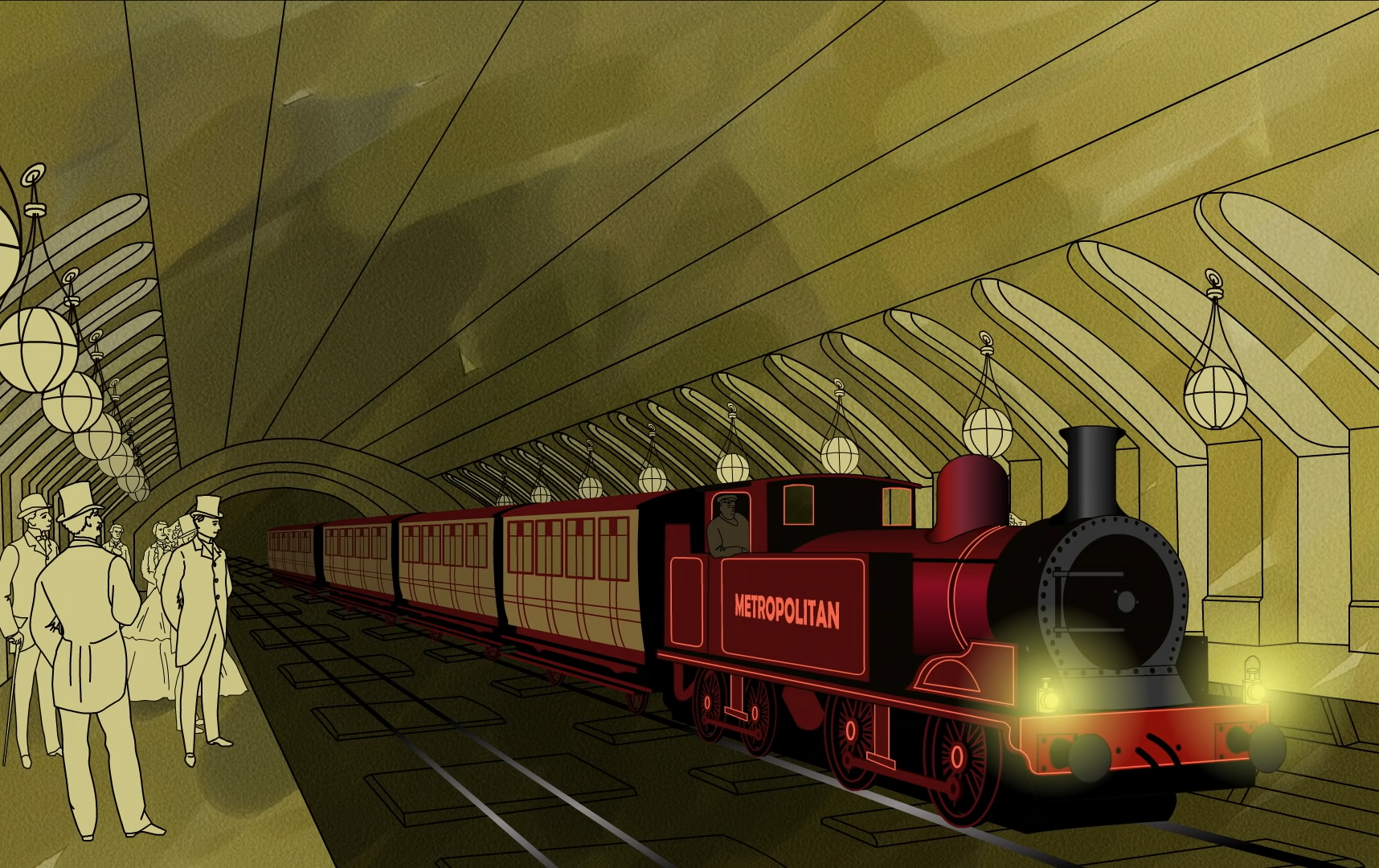
In 1860, work began on the first attempt to solve the problem: the world’s first underground railway. The Metropolitan Railway was designed to link three of London’s main line termini with the City.

On 10 January 1863, The Metropolitan Railway opens the world's first underground railway, between Paddington (then called Bishop's Road) and Farringdon Street. A second underground line, the District, began operating five years later.
In 1863, all of the trains used steam engines. Because these engines were powered by very hot water and fire, the tunnels were smoky, steamy, and noisy. The tunnels were dark, too. The train cars and stations were made of wood, and lighted with gas. Sometimes there were accidents because of fires. In 1890, it became the world’s first metro system when electric trains began operating on one of its deep-level tube lines.

Much of the central London network was completed in the first 50 years. The building method used for many years was a so-called “cut-and-cover” system. It was easier to dig out a large open hole in the road, build the arch of the false tunnel with bricks, and then refill the hole with the dug-out material.

Around the turn of the twentieth century the development of electric traction allowed much deeper tunnels to penetrate the heart of the city, leading to a second wave of construction.

On 18 December 1890, The City and South London Railway opens the world's first deep-level electric railway. It runs from King William Street in the City of London, under the River Thames, to Stockwell.

It wasn't until 1968 that the first new line across central London for more than 60 years - the Victoria line - opened, followed in 1979 by the Jubilee line. In 1999 the Jubilee line was extended to London's Docklands, facilitating regeneration and the growth of the Canary Wharf business district.
History of underground train in London

The most popular articles

Arts & Culture | Smithsonian Magazine

Selected articles