Showing posts with label London. Show all posts

Saturday, October 11, 2025

A Brief History of the London School of Economics and Political Science

The London School of Economics and Political Science (LSE) was founded in 1895 with a bold vision: to advance the study and understanding of society for the betterment of humanity. At the time, Britain’s political and business elite were seen as lacking adequate training in the social sciences, especially compared to their European counterparts. LSE’s founders—members of the Fabian Society Sidney Webb, Beatrice Webb, Graham Wallas, and playwright George Bernard Shaw—set out to change that. Drawing inspiration from the curriculum of the Paris institution Sciences Po, they designed a comprehensive programme that would cover economics, politics, sociology, and public administration. Notably, from its inception, LSE welcomed both men and women, making it one of the early British institutions to promote gender equality in higher education.

LSE quickly established itself as a pioneering center of learning. In 1900, it joined the University of London and was recognized as its Faculty of Economics. The following year, the BSc (Econ) and DSc (Econ) degrees were introduced—the first university qualifications in the world devoted exclusively to the social sciences. This marked a turning point in academic history, positioning LSE as a leader in shaping modern economics, politics, and sociology.

The two World Wars deeply affected the School. During World War I, many male students and faculty joined the military, leading to a temporary closure and, for the first time, a female-majority student body. In World War II, LSE was evacuated to Peterhouse College, Cambridge, to escape the Blitz, and 88 former students lost their lives in the conflict.

Postwar expansion brought new academic strengths. The Department of Social Policy was established in the 1950s, followed by the Department of Social Psychology in 1964. By the 1980s, LSE had become globally recognized for the excellence of its research, which was officially rated “outstanding” in 1986.

Over the decades, LSE’s campus expanded from its original Adelphi Terrace site to its current base around Clare Market and Houghton Street. In 2008, it began awarding degrees in its own name, and in 2022, LSE achieved full university status within the University of London—cementing its position as one of the world’s foremost institutions for the study of social sciences.
A Brief History of the London School of Economics and Political Science

Tuesday, July 2, 2024

Evolution of Hospital Institutions in England: From Early Foundations to Eighteenth-Century Advancements

An institutional focus in a hospital setting in England evolved significantly during the late eighteenth century. Archaeological discoveries across Britain have unearthed some of the world’s earliest hospitals, showcasing advanced infrastructure for their time. These hospitals boasted excellent plumbing and sewerage systems designed for optimal hygiene. Some even had flushing toilets where water effectively carried away waste, a testament to their sophisticated design. The buildings were divided into separate wards, likely to isolate infectious diseases, demonstrating an early understanding of contagion control.

One of the first organized hospitals in the United Kingdom was St. Bartholomew’s Hospital in Smithfield, London, founded in 1123. This institution was a pioneer in hospital care and was granted a Royal Charter by King Henry VIII in 1546, solidifying its importance in medical history. Another notable early hospital was St. Nicholas Hospital in Harbledown, near Canterbury. Founded in 1084 by Archbishop Lanfranc, it provided care for the outcast, aged, and infirm, emphasizing the role of hospitals in serving vulnerable populations.

In a significant archaeological discovery in 2010, researchers uncovered the ancient hospital of England in Winchester, Hampshire. Radio carbon analysis of the site revealed a date range of AD 960-1030 for a series of burials, many showing evidence of leprosy. This discovery highlighted the existence of organized healthcare facilities well before the institutional focus of the eighteenth century.

The eighteenth century saw the establishment of voluntary general hospitals across England, marking the beginning of formal teaching programs. Westminster Hospital (1719), Guy’s Hospital (1725), and St. George’s Hospital (1733) in London exemplified this new movement. These institutions laid the foundation for modern medical education and hospital care, significantly advancing the healthcare system in England.
Evolution of Hospital Institutions in England: From Early Foundations to Eighteenth-Century Advancements

Friday, March 8, 2024

Big Ben's Historical Journey

Big Ben stands as an enduring symbol of Great Britain, embodying the nation's rich history, resilience, and democratic principles. Situated adjacent to the Houses of Parliament, its iconic silhouette graces countless postcards, films, and tourist brochures, serving as a testament to British identity and political heritage.

The relationship between Big Ben and the Houses of Parliament is symbiotic, with the tower serving as a visual anchor for the legislative seat of power. Rising majestically above Westminster, Big Ben's presence underscores the significance of governance and democracy within the nation's collective consciousness.

Clarifying the terminology surrounding Big Ben is essential for understanding its multifaceted identity. While often used interchangeably, Big Ben refers specifically to the Great Bell housed within the tower. The structure itself is officially known as the Elizabeth Tower, with the clock face bearing the title of The Great Clock, and the tower itself was formerly called The Clock Tower.

The origins of Big Ben trace back to Westminster's early timekeeping endeavors. The installation of the first clock in the 13th century marked the initial steps towards precision timekeeping in the region. However, the original tower was demolished in 1707, paving the way for future developments.

The decision to erect a new clock tower arose in 1844, amid growing demands for improved parliamentary infrastructure. Becket Denison spearheaded the design and tender process, ultimately awarding the contract to Edward John Dent's company in 1852. This marked the genesis of what would become Big Ben.

The development of the clock tower progressed swiftly, with the installation of bells and meticulous attention to detail. The decision for four quarter bells and one hour bell ensured optimal timekeeping accuracy. In 1859, the tower was completed and opened to the public, with the Great Bell affectionately named "Big Ben" in tribute to Sir Benjamin Hall, the Chief Commissioner for Works.

In 2012, the tower was officially renamed The Elizabeth Tower, in honor of Queen Elizabeth II's Diamond Jubilee. This gesture underscores the tower's enduring legacy and its continued relevance in the modern era, as a beacon of British tradition and democratic ideals.
Big Ben's Historical Journey

Monday, October 24, 2022

History of underground train in London

The first subway system was proposed for London by Charles Pearson, a city solicitor, as part of a city-improvement plan shortly after the opening of the Thames Tunnel in 1843.

Pearson published a pamphlet in 1845 detailing an underground railway though London’s Fleet Valley. In 1846, Pearson went before Parliament to detail the plan.

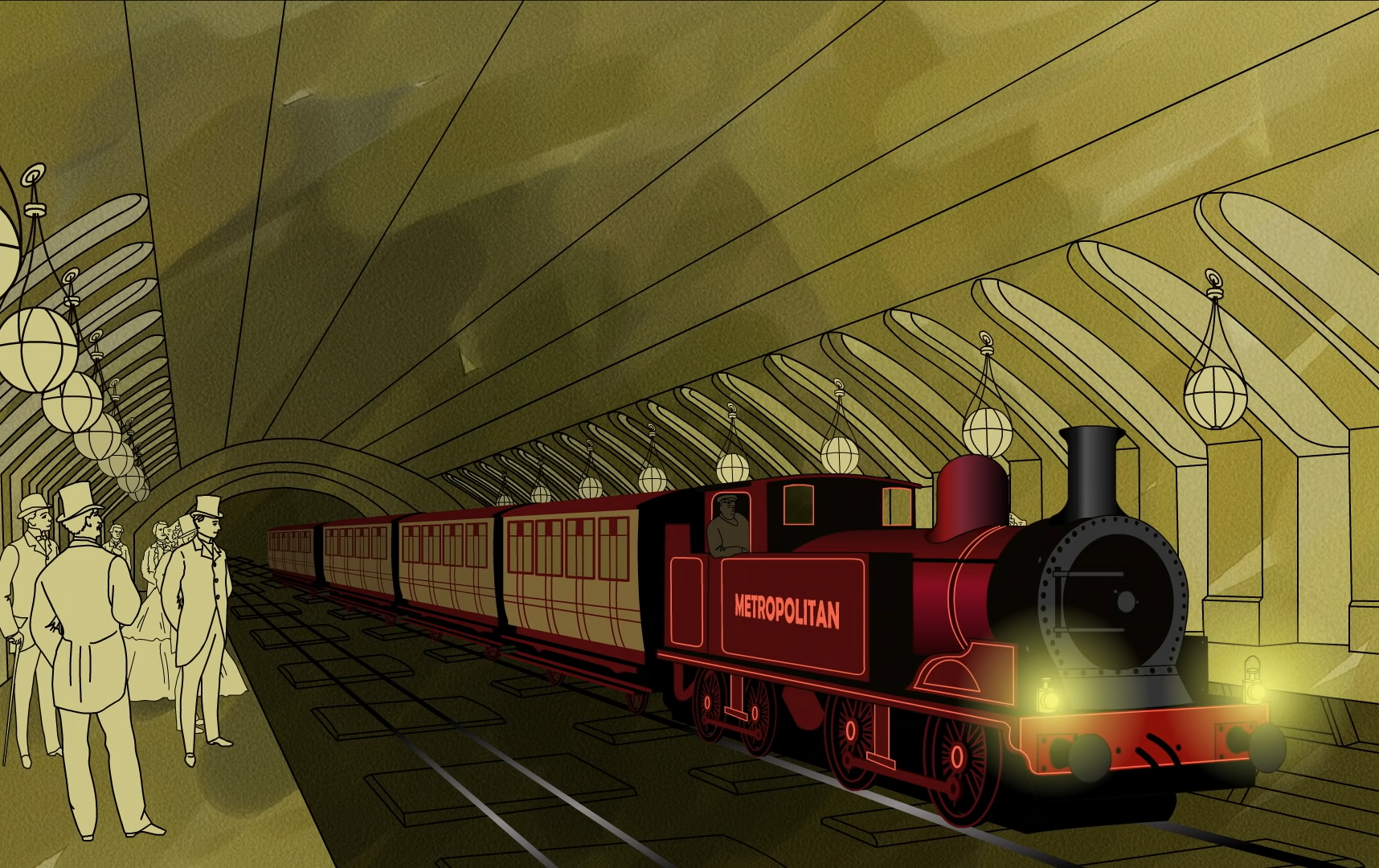
In 1860, work began on the first attempt to solve the problem: the world’s first underground railway. The Metropolitan Railway was designed to link three of London’s main line termini with the City.

On 10 January 1863, The Metropolitan Railway opens the world's first underground railway, between Paddington (then called Bishop's Road) and Farringdon Street. A second underground line, the District, began operating five years later.
In 1863, all of the trains used steam engines. Because these engines were powered by very hot water and fire, the tunnels were smoky, steamy, and noisy. The tunnels were dark, too. The train cars and stations were made of wood, and lighted with gas. Sometimes there were accidents because of fires. In 1890, it became the world’s first metro system when electric trains began operating on one of its deep-level tube lines.

Much of the central London network was completed in the first 50 years. The building method used for many years was a so-called “cut-and-cover” system. It was easier to dig out a large open hole in the road, build the arch of the false tunnel with bricks, and then refill the hole with the dug-out material.

Around the turn of the twentieth century the development of electric traction allowed much deeper tunnels to penetrate the heart of the city, leading to a second wave of construction.

On 18 December 1890, The City and South London Railway opens the world's first deep-level electric railway. It runs from King William Street in the City of London, under the River Thames, to Stockwell.

It wasn't until 1968 that the first new line across central London for more than 60 years - the Victoria line - opened, followed in 1979 by the Jubilee line. In 1999 the Jubilee line was extended to London's Docklands, facilitating regeneration and the growth of the Canary Wharf business district.
History of underground train in London

Thursday, December 16, 2021

History of St Thomas's Hospital

St Thomas's Hospital had its origins as the infirmary of the Augustinian Priory of St Mary Overy and was run by the 11 brothers and sisters of the monastery.

The hospital was established in 1173 and dissolved in 1540. The infirmary assumed the name of St Thomas the Martyr shortly after his canonization in 1173. St Thomas the Martyr (St. Thomas Becket) was Archbishop of Canterbury from 1162 until his murder in 1170 (he was slaughtered by the King’s knights).

Following a disastrous fire in 1212, the priory and the hospital developed quite separately. The site opposite the priory in Long Southwark (later known as Borough High Street) was acquired by the hospital in 1215 and occupied until 1862.

During the Reformation in 1540 the hospital, along with many other religious foundations, was dispossessed of its revenues and closed. The Hospital was refounded by royal charter in 1551, one of five major endowed royal hospitals established in London in the mid-sixteenth century, which also include Bridewell. The hospital re-opened with 120 beds and three Barber Surgeons, assisted by apprentices, were appointed, possibly marking the beginning of St Thomas's Hospital Medical School.

In 1649 Thomas Wharton (1614- 1673) was appointed an anatomist at St Thomas’ Hospital. His work gave the first thorough account of the glands of the human body, which Wharton classified as excretory, reductive, and nutrient. In 1657, Wharton was appointed physician to St Thomas’s Hospital, London, a post he held for the rest of his life.

St Thomas’ Hospital taught students from the 16th century. In 1726. St Thomas offered teaching as a joint undertaking with Guy’s Hospital.

In 1859 Florence Nightingale became involved with Saint Thomas' setting up on this site her famous nursing school, the Nightingale Training School.
History of St Thomas's Hospital

Thursday, July 8, 2021

Red phone box

London is a city unified by small highlights of color; the brought red phone booths mailboxes and double decker buses; the black taxis; and black and white street signs.

The red telephone box was designed by Sir Giles Gilbert Scott (1880- 1960). Scott's design of the K2 (stand for Kiosk 2) cast iron telephone kiosk won a Post Office sponsored competition in 1924.

The red K2 telephone box was introduced to the streets of London in 1926. K2 was 3ft 6in wide and deep, stood 9ft 4in in height and weighed around 2756 lb (1250kgs). It took over from the K1 (Kiosk 1) which was a concrete structure.

His updated K6 design followed in 1935. The K6 was essentially a smaller and more streamlined version of the K2. The red K6 public telephone box, first seen on the streets in 1935 and in continuous production for over 30 years.

Under Prime Minister Margaret Thatcher, the phone service had been taken away from the post office in 1984 and given to a new private company, British Telecom.
Red phone box

Sunday, April 4, 2021

Peasants' Revolt in 1381

The Peasants' Revolt started in Essex on 30 May 1381, when a tax collector tried, for the third time in four years, to levy a poll tax. King’s commissioners are attacked in Fobbing in Essex whilst trying to collect new poll tax. Three commissioners are beheaded and their heads put on poles and paraded around nearby villages.

The England which in 1381 was ruled by the boy-king Richard II, with Archbishop Sudbury as his chancellor and prime minister, and Sir Robert Hales as his treasurer, was a thoroughly discontented country.

Richard II's war against France (the next phase of the Hundred Years War) was going badly, the government's reputation was damaged, and the tax was 'the last straw'.

The seeds of dissent fell from the tree that was medieval society itself and were watered by the continuous oppression of the poor in towns as well as the countryside by those in power.

Artisans, parish priests, poor city workers, and even small traders rose with the peasants in their call for the abolition of feudal obligations (serfdom) and the resulting economic/social injustice they had endured for so long.

By June, peasant numbers had reached about 60,000. Peasants are armed with axes, scythes, some even have swords and bows and arrows.

Soon both Essex and Kent were in revolt. The rebels coordinated their tactics by letter. Hundreds of angry peasants marched from Kent to London and captured the Tower of London. They murdered the Archbishop of Canterbury and the treasurer and then demanded to meet the king.

On 15 June, King Richard II, met the rebels' leader Wat Tyler. William Walworth, the Lord Mayor of London, attacked and killed Tyler. Before the rebel army could retaliate, Richard stepped forward and promised to abolish serfdom. The peasants went home, but later government troops toured the villages hanging men who had taken part in the Revolt.
Peasants' Revolt in 1381

Sunday, October 28, 2018

Great Fire of 1666

London was a busy city in 1666. It was very crowded. The streets were narrow and dusty. The Great Fire of London is one of the most well-known disasters in London’s history. It began on Sunday evening 2nd of September 1666 and lasted just under five days.

It started at 1 am in Pudding Lane in the shop of the king’s baker, Thomas Farrinor. When Thomas went to bed, he did not put out the fire that heated his oven. Sparks from the oven fell onto some dry flour sacks and they caught fire.

The fire spread easily because London was very dry after a long, hot summer. The area around Pudding Lane was full of warehouses containing highly flammable things like timber, rope and oil. The flames spread through the house, down Pudding Lane and into the nearby streets.

The fire swept through the city of London, gutting most of the medieval city, destroying parish churches, thousands of homes and wiping out landmarks such as St. Paul’s Cathedral. The fire forced thousands of Londoners to flee their homes and caused havoc through the city.

The fire still spread, helped by a strong wind from the east. London Bridge and St Paul’s Cathedral were both burnt. There was no fire brigade in London in 1666 so Londoners themselves had to fight the fire, helped by local soldiers. They used buckets of water, water squirts and fire hooks. Equipment was stored in local churches.

On Tuesday, King Charles II ordered that houses and shops be pulled down to stop the fire from spreading. By Wednesday, they had the fire under control. Some places still smouldered for months afterwards. Only 51 churches and about 9000 houses were rebuilt. St Paul’s Cathedral was ruined, as was the Guildhall (the offices of the Lord Mayor) and 52 livery company halls.
Great Fire of 1666

Monday, April 16, 2018

Windsor Castle

In January 1066, Saxon monarch Edward the Confessor died, signaling the next and final successful invasion of England. Windsor Castle was built by these Norman conquerors.

Windsor castle was originally built by William the Conqueror, in the eleventh century. After he returned from his victory at the Battle of Hasting in October, he ordered the construction of a ring of defenses around London. The stronghold at Windsor, on the high cliffs overlooking the approach to London along the Thames, was one of these.

Windsor Castle seems to have been intended by William the Conqueror more for a military post, for which by its situation it was well adapted than for the residence of himself and his successor.

It has been the favorite country residence of the English kings for upwards of 700 years. It stands on a high, and commands a beautiful view of the Thames and the surrounding counties.

By the reign of Henry I (r. 1100 - 35) the creation of a large hunting forest, together with the proximity of London, made the castle a favored royal residence as well as a fortress. Windsor Castle began it transformation from wood to stone under Henry II, in the latter half of the 12th century.

Edward III, rebuilt the old castle, and added St. George’s chapel; and numerous changes were made by succeeding sovereigns, particularly by Charles II.

In the 1980s restoration began on the Round Tower, and in 1992 the northeast corner of the castle, including St. George’s Hall, the private chapel and the State Dining Room, were badly mages by fire.
Windsor Castle

Wednesday, January 31, 2018

Madame Tussaud

Madame Tussaud’s establishment in London, founded in 1835, is the most long-lived and famous wax museum. Madame Tussaud was a very remarkable woman. She survived the French revolution, brought her waxworks to England, and made them the most popular tourist attraction in London.

Marie Tussaud was born as Marie Grosholz in late 1761 in Strasburg, France and died in 1850. Tussaud's widowed mother moved her children to Switzerland, where they lived with Phillipe Curtuis, a talented sculptor of wax heads.

While living in the home, Marie learned the trade of wax modeling and later took her talents to the aristocrats. Tussaud knew many of the leading figures of pre-revolutionary Paris and indeed was invited to live at the Royal Court in Versailles to be the art tutor to King Luis XVI’s sister.

Her sympathies toward the king led to her incarceration during the Revolution, and she was forced to make death masks of the royalty she once adored. Some of Tussaud's more famous works were the likes of Marie Antionette and other prominent French figures; she also made casts of victims of the guillotine.

In 1802, Madame Tussaud left France and took her collection of death masks to England, where they were put on display in what later became known as the “Chamber of Horrors.” Her museum contains of the great contemporaries, including Voltaire and Benjamin Franklin. By the turn of the 21st century branches of her museum were located throughout the world.
Madame Tussaud

Thursday, November 23, 2017

History of Trafalgar Square

In 1839, nearly 35 years after the Battle of Trafalgar (20 October 1805), British Parliament decided to commemorate Admiral Horatio Nelson’s victory over the French.

Nelson went to sea at age of 12 and became admiral at the age of 39. He was a hero of the Battle of Calvi in 1794 where he lost an eye, the Battle of Santa Cruz (1707) where he lost an arm and the Battle of Trafalgar where he lost his life.

In the naval Battle of Trafalgar, British won a stunning victory over combined French and Spanish navies in 1805.

A huge square was cleared in the center of London and it was designed and laid out by Victorian architect Nash, between 1829 and 1850.  And a column almost 60m tall was placed in the middle of it.

The square was named Trafalgar square and a statue of Nelson was placed on top of the column.  Queen Victoria’s favorite animal painter, Sir Edward Landseer, added the four lions at the base of the column in 1868.

Since its construction, Trafalgar Square has a long history of use as a forum for social protest.

Anti-imperialism, along with other concerns such as the rights of workers and women, are just a few of the social movement that have used the square to proclaim their message.
History of Trafalgar Square

Thursday, October 26, 2017

Kensington Garden

In 1726, George I approved ambitious plan that had been prepared by the Royal Gardener, Henry Wise with his assistant Charles Bridgeman.

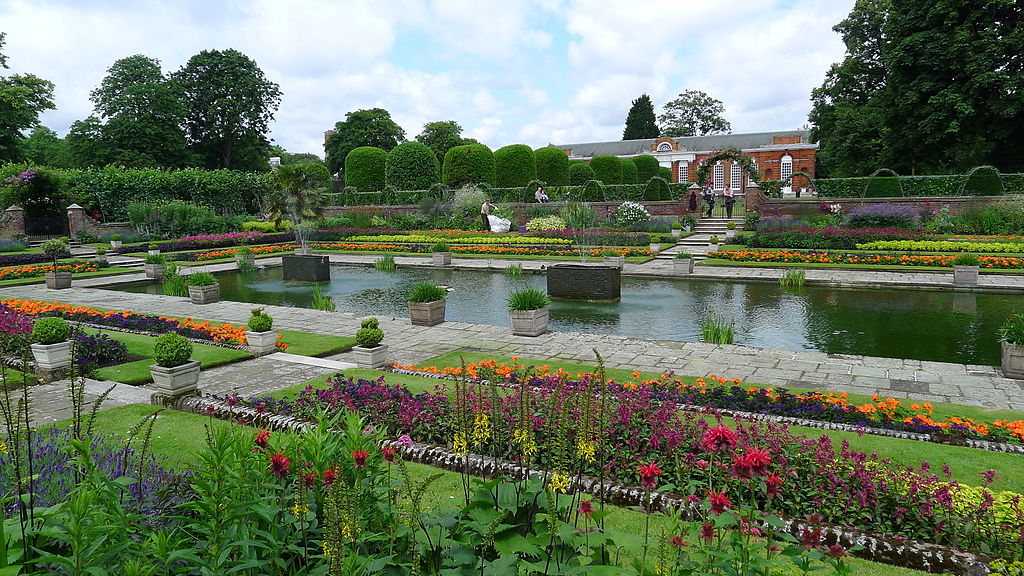
Kensington Gardens belonged to Kensington palace; the gardens were laid out between 1728 and 1738 were first opened to the public in the mid-eighteen century, and contain a pond point, formal avenues, a sunken Dutch garden and an orangery.
It was Queen Caroline however, wife of George II wife enthusiastically implemented of the Kensington Gardens which still remain today. It was Bridgeman who created the Serpentine water feature; this lake being divided into parts the uppermost end known as Long Water, which includes the very ornate and attractive Italian Garden. Bridgeman had created a park designed for civilized men and women, where they could walk and admire this elegance scene.

In the 1770s Kensington Gardens incorporated a wide variety of landscape garden design, including the remains of a formal Dutch garden dating from the building of the palace, and an Orangerie designed by Wren and sunken garden by Henry Wise both for Queen Anne.
Kensington Garden

Tuesday, October 3, 2017

History of Buckingham Palace

London remained the principal residence of the monarch, and hence the main seat of government.

The old Palace of Whitehall was all but destroyed by fire in 1698 and so the eighteenth-century monarchs made the Palace of St James their principal London residence until 1762.

The first house on the site was built in 1633. In 1702, Lord Arlington’s heirs sold the house to John Sheffield, the first Duke of Buckingham.

The duke did not consider his purchase grand enough for his position and cleared the site for a new house built slightly to the north with it main façade facing east aligned with The Mall. Buckingham House was built in 1702, designed by William Talman and completed by Capitan William Winde.
Buckingham House was intended to overawe William III’s inferior accommodation at St James Palace. 

George III acquired the property in 1762 for his private residence so that his young bride, Queen Charlotte could have a quiet place to retreat from the rigid formality of court at nearby St. James’s Palace.
When George IV came to the throne, he directed his architect, John Nash to remake the place into a theatrical showplace, worthy of being the official center of his resplendent court.

The King did not live to see the place finished. His brother, William IV, never moved there either; and when Queen Victoria came to the throne in 1837 it was scarcely habitable.

In 1837, Queen Victoria, became the first monarch to inhabit the new palace.
History of Buckingham Palace

Tuesday, July 4, 2017

London Paddington station

This first station opened for business in June 1838 and initially the trains ran only as far as Taplow, near Maidenhead, until the workable line was completed in stages.

The original station was very basic and consisted of wooden roofs supported by slender iron columns. It was at this station that Queen Victoria arrived on completing her first railway journey in 1842, o9 the Phlegethon, which travelled at 44 mph.
Its cluster of wooden structures soon proved woefully inadequate however and the company directors gave the go-ahead for the construction of a new terminus in late 1850. The terminal was designed by engineer Isambard Kingdom Brunnel (1806-1859) with the assistance of architect Matthew Digby Wyatt (1802-1877).
Built between 1850 and 1854, it was one of the first stations to utilize the iron-arched roof and the ridge-and-furrow roof glazing also employed in Joseph Paxton’s Crystal Palace of 1851. In 1854, the Great Western Hotel was opened adjacent to the station.

In 1921 Great Western Railway employed 3000 people at Paddington Station.
London Paddington station

Tuesday, December 13, 2016

City of London Corporation

In 2006, the name Corporation of London was change to The City of London Corporation to avoid confusion the Greater London Authority.

The Corporation of London itself origin as far as 1111, was regarded as one of the great institutions of the Ancient Constitution.

Greater London consists of the 32 London boroughs (divided among Inner and Outer London) and the City of London. Unlike the boroughs, the City is governed by the City of London Corporation, which is granted with greater-than-usual powers and authority compared to other local governments.

The City of London Corporation is municipal government for the City of London, dating from the 14th century; it is the oldest organization of its kind in the world. The full name of the Corporation, rarely used outside of official contexts, is the Mayor and Commonalty and Citizens of the City of London and the Court of Common Council.

The City of London Corporation has 3 roles: it helps London’s communities by operating in partnership with neighboring boroughs on financial regenerations an capabilities tasks. City of London Corporation supports appear just after important London heritage and green spaces.

 It also helps and promotes the City as a world –leading monetary and organization hub, with outward and inward small business delegations, high-profile civic occasions, research-driven policies plus a long-term tactic.

Important features of the financial industry that so dominates the City include the London Stock Exchange one of the largest in the world, operating since 1801.
City of London Corporation

Friday, July 22, 2016

Imperial College of Science and Technology

Imperial College has roots in three nineteenth-century institutions, the Royal College of Chemistry, the Royal School of Mines, and the City and Guilds Central Technical College, which opened respectively in 1845, 1851 and 1885.

In 1904, the Board of Education appointed a departmental committee, under the chairmanship of Lord Haldane, to study possible co-operation between institutions.

The conclusion of the report led to the establishment by Royal Charter of the Imperial College of Science and technology in 1907 and joined the University of London.  The main campus of the college was constructed in 1907 following the newly established Board of Education.
Imperial College
The college received its mandate in Article II of the Charter namely ‘to give the highest specialized instruction and to provide the fullest equipment for the most advanced training and research in a various branches of science especially in it application to industry’.

In 1988 St Mary’s Hospital Medical School was merged with the college. Imperial became fully independent of the University of London in July 2007

Imperial College is recognized today as being one of the top colleges in the word as a science based institution attracting over 16,000 students of international quality, specializing in science, medicine, engineering, and business studies.
Imperial College of Science and Technology

Tuesday, June 14, 2016

London Eye

A predecessor to the London Eye, the Great Wheel at Earls Court, 300 feet high and revolving form 1894 to 1907, was one of London’s premier turn-of-the-century outdoor attractions. It was demolished in 1907.

The London Eye is a relatively new attraction, opened officially on 31 December 1999 but for visitors only in March 2000, for technical reason. It was originally called the Millennium Eye to celebrate the turn of the millennium, was originally intended to close after five years.

This is the world’s largest observation wheel. It stands 135 m high on the south bank of the River Thames.

Architects David Marks and Julia Barfield’s design won a competition of construction projects coinciding with the start of the third millennium and it took 6 years to realise.
London Eye

Wednesday, May 4, 2016

Double-decker bus in London

Horse-drawn double-decker buses first were produced in 1847 by Adams & Company of Fairfield, England. This early bus featured a clerestory roof with built-in wooden bench seats running horizontally along the length of the vehicle.

These open-top busses were run by the Economic Conveyance Company of London, which encouraged people to ride by offering half-price fare for those sitting on the top deck.  The unique top deck was built to carry more passengers and the old fashioned bus did not have doors which allowed passengers to get on and off quickly.

In 1852, John Greenwood built a larger double-decker that could transport 42 passengers and was pulled by three horses instead of just two.

The Routemaster – the iconic red double-decker buses associated with England were specifically designed for use on London streets.

Developed in the late 1940s and early 1950s by London Transport, and built to take on double the passengers of a standard bus, the Routemasters were manufactured by the Associated Equipment Company and Park Royal to replace the failing electronic trolley busses.

The Routemaster double-decker bus had first taken to the streets of London in 1956 and had lived a long and prosperous life until it had been taken out of service on December 9, 2005. Nearly 2,900 Routemasters were built between 1957 and 1968.
Double-decker bus in London


Monday, March 7, 2016

Motorway in England

The motorway concept is remarkable in that it originated so early: only some twenty years after Benz and Daimler produced the first motor cars.

Writing in the Nineteenth Century magazine in 1902, British engineer B.H Thwaite proposed the construction of an arrow-straight motorway from London to Birmingham.

In 1906 a road, virtually of motorway standards was proposed from London to Brighton though nothing came of the proposal.

Britain’s first motorway was the 13 km Preston by pass and it was opened in December 1958 at the beginning of a major new road building programme. In the 1960s, contracts were signed for many miles of motorways and pans were laid to upgrade much of the existing network.

That policy continued into the 1980s, at a large speed largely determined by the funding allocated by the Treasury. Motorway building spread at a brisk space. Stretches of the M60 and M6 appeared during 1960-3; the first section of the A1 (M) was competed in 1962 and the M5 the following year.

The early seventies saw a dramatic expansion, with the M4 linking London and Bristol the M40 reaching towards Oxford and Birmingham and the cities of Liverpool, Leeds, Manchester and Sheffield all being interconnected.

By 1980, 2286 km of motorway were in use in England alone.
Motorway in England

Thursday, February 11, 2016

Westminster Bridge

A suggestion for a bridge here was made in 1664, but was vigorously resisted by Londoners.

Fourteen years after failure of the Westminster Bridge Bill of 1722, a petition was again presented to Parliament by the Burgesses, Freeholders and Inhabitants of Westminster in February 1736, arguing that the great increase in buildings and population made a new bridge essential.

An Act was obtained, Commissioners were appointed, and £5 lottery tickets were sold to raise the necessary £625 000.

The architect of Westminster Bridge was Charles Labelye, a native of Switzerland: the first stone was laid by the Earl of Pembroke, on January 29, 1738-9.

Labelye is credited with the introduction of the caisson method of building foundations, which is said to have been first used on the Westminster Bridge.

It consists of fifteen semicircular arches, the centre seventy-six feet span; it is 1223 feet long by 44 feet wide. It was originally intended for a wooden bridge, and was partly commenced on this principle.

It had two footways, with a ‘Horse Road’ thirty feet across where horses had a sleep climb to the central arch.

The original Westminster Bridge was a stone structure opened in 1750 which was only the second to be built across the Thames where it flowed through the Metropolis.
Westminster Bridge

The most popular articles

Arts & Culture | Smithsonian Magazine

Selected articles